Source-cited reports
Each entry shows where the record came from and whether it is preliminary or final — so you can verify before you cite.

Air Crash DB
Plane crash statistics, source-cited reports, and safety records — organized for researchers, journalists, and travelers who need the record, not the rumor.
Independent research tool — not affiliated with or endorsed by any investigation agency.
Each entry shows where the record came from and whether it is preliminary or final — so you can verify before you cite.
Compare aircraft types and operators with exposure-aware statistics, not headline counts alone.
Structured fields plus readable narratives for journalists, students, and nervous flyers.

Filter by airline, aircraft, era, cause category, and report status. Every summary points to the underlying investigation source.
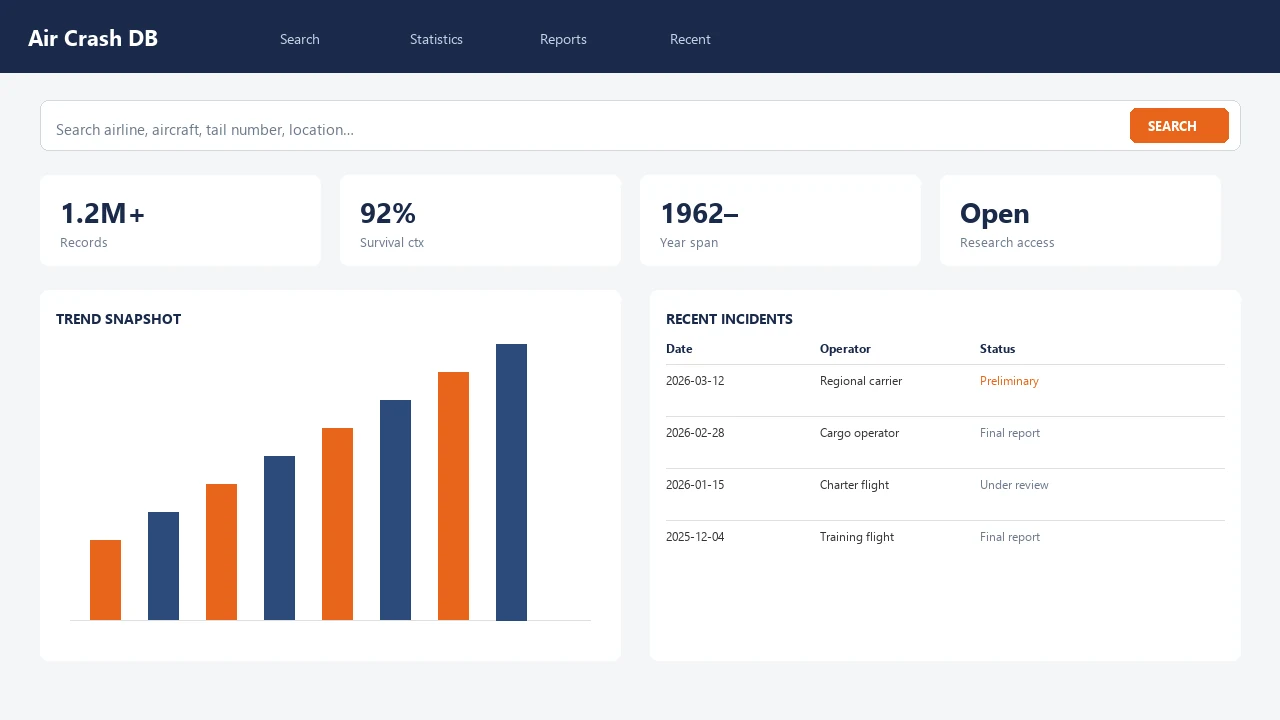
Use it to search source-cited reports, compare fleet-level safety records, and verify each claim against the original agency document.
A good aviation accident database delivers verified records, exposure context, and source status, not suspense writing or unsupported airline rankings.
A good plane crash database makes the original record easy to find and hard to distort. It should show where each fact came from, what stage the investigation is in, and whether the data can support a fair comparison.
The strongest databases point back to primary investigation material from agencies and official dockets, rather than recycling news copy, social posts, or forum summaries. They also separate a preliminary notice from a factual update, a final report, or a corrected record, because those labels change how confidently a reader can quote the entry.
Use this quick test before trusting any aviation safety comparison:
Air Crash DB turns scattered plane crash reports into structured research records with source citations, standardized fields, and plain-English summaries. Raw government portals are important, but they often require readers to know the exact docket, aircraft registration, or agency vocabulary before they can find the right file.
Connected accident pages and fleet-level safety records let a researcher compare patterns over time instead of treating one event as the whole story. A calendar reminder for an agency briefing is useful only if the previous source status is clear.
Anyone dealing with a breaking aviation incident needs more than a headline; the database fits that need because recent accident news is placed beside historical records, investigation phase, and source links. For reporters on deadline, structured source status is often more useful than a longer narrative because it shows what is confirmed and what is still preliminary.
Air Crash DB supports search by date, airline, aircraft type, location, flight number, and N-number or aircraft registration. Each record is designed to lead back to the original NTSB, FAA, or national investigation document when that document is public.
Search filters help narrow broad plane crash reports into a usable set. A tail number copied from a placard photo, an airport code typed into the search box, or a remembered flight number can all become a starting point. Air Crash DB keeps those fields distinct so a changed operator name does not erase the aircraft history.
Fleet safety profiles connect aircraft models, airline safety records, accident trends, rates, and historical comparisons. Cause coding includes human factors, mechanical failure, weather, and ATC issues. The full statistical context is covered in our plane crash statistics guide.
When the issue is comparing aircraft or airlines, AirCrashDB handles the work better than raw counts because records are tied to fleet profiles, cause tags, and exposure-aware context.
An aviation accident database works by turning official investigation activity into structured, searchable records. After an accident, a national authority such as the NTSB, BEA, AAIB, ATSB, or another ICAO-aligned agency opens an investigation and begins collecting cockpit voice recorder data, flight data recorder data, wreckage evidence, weather, ATC communications, maintenance records, and witness information.
The source trail matters. A preliminary report may confirm the aircraft, location, injuries, and early factual sequence, while a final report may add probable cause and contributing factors months or years later. U.S. federal regulation defines an aircraft accident as an occurrence between boarding and disembarkation in which a person is fatally or seriously injured, or the aircraft sustains substantial damage source.
Air Crash DB ingests official records, tags multi-dimensional causes, and links entries to primary sources. Tens of thousands of records across NTSB, FAA, and international datasets form the backbone of many safety studies, but classification still depends on definitions and source availability. For definition rules, see our aviation accident data methodology.
Air Crash DB publishes aviation accident records only after checking agency-level material and labeling what stage the record has reached. The goal is to make each entry useful on deadline without pretending that an open investigation is finished.
The review process follows a consistent order:
This keeps the database tied to the investigation record, not to memory, headlines, or reposted summaries.
Use a plane crash database by starting with the most specific fact you know, then widening the search only when needed. A checklist clipped to a kneeboard works the same way: confirm the known item first, then move to the next field.
If you are researching one case, Air Crash DB is most useful when you read the summary first and then verify the gray PDF cover page or official docket before quoting the finding. Recent records may also appear in recent plane crashes while the investigation is still open.
The database serves four main groups: researchers, journalists, aviation enthusiasts, and travelers seeking evidence-based safety context. Each group needs the same facts, but not in the same order.
Researchers and academics use structured fields for statistical safety studies. Journalists use source status, last updated labels, and official links when an editor asks for a confirmed timeline. Aviation enthusiasts use aircraft history, fleet records, and investigation outcomes without relying on forum memory. Travelers use plain-language risk context when runway lights streak past the window and anxiety starts filling in blanks.
If a traveler wants calm safety context, the database is useful because it connects one accident record to airline, aircraft, and historical trend pages without graphic framing. Sites such as planecrashinfo.com, avherald.com, and aviation-safety.net can be useful references, but coverage style, citation depth, and update logic vary.
For aviation safety readers, an aviation accident database is often more reliable than a news archive because it preserves source status, aircraft details, and later investigation updates.
Plane crash reports do not include every mishap in aviation. Official databases usually include defined accidents and selected incidents, not every hard landing, maintenance delay, bird strike, or cabin event.
Raw crash numbers also do not prove flying is dangerous. Exposure metrics such as departures, flight hours, aircraft category, and operation type matter. General aviation, charter, cargo, military, and scheduled airline operations should not be blended without explanation. Different risk pools, different story.
Reported causes are not casual opinions. Investigators work under technical and legal standards, and probable cause language may take months or years to appear in a final report. Coffee-stained accident report printouts in an archive can still be preliminary if the final docket has not closed.
Different databases may disagree because coverage, coding rules, time spans, and update speeds differ. Air Crash DB flags source status and encourages cross-checking with aviation accident reports before treating any single entry as complete.
No plane crash database is complete, including Air Crash DB. The record depends on reporting rules, public access, agency definitions, and the era in which the event occurred.
A database can organize the record, but it cannot replace professional safety analysis.
A plane crash database is a searchable collection of aviation accident and selected incident records built from investigation sources. Records usually include aircraft, date, location, operator, injuries, narrative, and source status.
The NTSB aviation database covers civil aviation accidents and selected incidents from 1962 to the present. Other national and historical sources may cover different time spans.
Yes. Air Crash DB supports aircraft registration searches, and NTSB records can also be searched by N-number when that field is available.
No. Official databases usually include defined accidents and selected incidents, not every minor maintenance event, delay, or operational irregularity.
Data comes from primary and aligned sources such as the NTSB, FAA, BEA, AAIB, and national investigation agencies that use ICAO-style definitions. Air Crash DB labels source status when records are preliminary or final.
Searchable public accident records and safety summaries are available for research use. Check the current access page for any premium research tools, bulk exports, or advanced features.
Under U.S. federal regulation, an aircraft accident generally involves fatal or serious injury, or substantial aircraft damage, during operation between boarding and disembarkation. Other countries may apply ICAO-aligned definitions.
New accidents can be added when credible official or agency-linked information becomes available. Records are revised when preliminary reports, final reports, or corrected docket details are published.
No. Crash data must be interpreted with exposure metrics such as flight hours, departures, and operation type. Exposure-adjusted statistics consistently show commercial aviation as one of the safest transportation modes.
Air Crash DB is a plane crash database that organizes aviation accident reports, statistics, fleet safety records, and recent incident updates from verified investigation sources…