
Plane Crash Statistics By Year And Fatality Trends

Plane crash statistics by year show that aviation accident counts have generally declined over recent decades, while fatality totals can still spike in individual years because one major crash can change the annual total. The safest interpretation compares raw accidents, fatal crashes, deaths, operation categories, and exposure measures such as flight hours or passenger miles.
Definition: Plane crash statistics by year are annual counts of aviation accidents, fatal crashes, injuries, and deaths, usually separated by operation type, geography, aircraft category, and exposure level.
TL;DR
- Raw annual crash totals are useful, but they do not measure risk unless they are compared with flight volume, passenger miles, or flight hours.
- General aviation and small aircraft usually drive annual accident counts, while scheduled commercial airline crashes are much rarer.
- Fatality totals fluctuate more than accident totals because a single high-casualty crash can make one year look unusually dangerous.
Plane Crash Statistics By Year At A Glance
Plane crash statistics by year are most useful when they separate long-term accident trends from single-year fatality spikes. Over recent decades, aviation accident counts have generally declined while the number of flights and passengers has grown.
Fatal crashes by year are noisier than total accident counts. One large loss can change the annual death total, even if the broader safety trend is stable. General aviation also dominates many yearly accident tables, so a raw total may say more about private and small-aircraft flying than airline travel.
The column labels matter.
For risk, rates per flight hour, departure, or passenger mile are more informative than raw counts. Tools like Air Crash DB organize annual aviation accident records with source status, operation category, aircraft type, fatalities and survivors, and investigation phase so readers can separate the record from the rumor.
Before You Compare Plane Crash Statistics By Year
Before you compare plane crash statistics by year, make sure the table is measuring the same thing from one row to the next. A clean annual chart starts with scope, definitions, and exposure, not the biggest number in the column.
- Identify the event type before reading the trend. Accidents, incidents, fatal accidents, fatalities, injuries, and hull losses answer different questions, even when they sit in the same annual summary.
- Check the geography so a U.S.-only table is not compared with a global, regional, airline, or operator-specific dataset.
- Confirm the operation mix by seeing whether general aviation, military flights, helicopters, experimental aircraft, cargo, charter, and scheduled airlines are included or excluded.
- Look for exposure measures such as departures, flight hours, flights, or passenger miles. Without them, the table shows volume of recorded events, not the rate of risk.
- Treat recent years carefully because preliminary records can change after investigations, final reports, and classification decisions are completed.
If those checks are missing, the table may still be useful, but it should be read as a rough count rather than a settled safety comparison.
Five Facts About Annual Air Crash Trends
- Total aviation accidents per year have generally declined over the last few decades, even as commercial air travel volume has expanded in many regions.
- Fatality totals can spike because one or two rare catastrophic events may dominate an annual death count.
- Most accident counts include general aviation, not only scheduled airline crashes, unless the table clearly says “commercial airline only.”
- Exposure-adjusted rates, such as accidents per flight hour or passenger mile, are more meaningful than raw annual counts.
- Human factors, including training, decision-making, fatigue, and procedural compliance, remain major contributors despite better aircraft reliability.
The better annual tables make those distinctions visible. A row that mixes a student pilot landing accident with a scheduled international airline crash can be accurate, but not very helpful unless the operation category is labeled.
Glossy photo annex thumbnails can look dramatic. The data table should stay boring.
How Plane Crash Statistics By Year Work
Plane crash statistics by year work by grouping aviation events into defined categories, then assigning each event to a year, jurisdiction, aircraft type, operation category, and investigation status.
An accident usually involves substantial damage, serious injury, or death under the applicable reporting rules. An incident is a safety event that may not meet the accident threshold. A fatal accident has at least one death. A fatality is a person who died. An injury may be serious or minor. A hull loss means the aircraft was destroyed or not economically repairable. An investigation is the official process that determines facts, findings, and probable cause where that system uses the term.
Annual tables differ because NTSB, FAA, Aviation Safety Network, and international archives do not always use the same scope. The gray PDF cover page of a final report may classify an event differently than early wire copy did. According to the Aviation Safety Network summary cited in public aviation accident references, from 1970 through July 2025 there were 11,164 aviation incidents worldwide resulting in 83,772 fatalities source.
For U.S. civil aviation, primary checks should start with NTSB accident data and FAA activity measures; for global commercial-airline context, compare those records against ICAO, IATA, or Aviation Safety Network summaries before merging counts.
How To Use Aviation Accidents By Year Tables
Use aviation accidents by year tables by fixing the scope first, then reading fatalities, operation category, and exposure together. A single calendar year is not proof of a safety reversal.
Before you trust a year-over-year comparison, confirm that both rows use the same geography, operation type, accident definition, and update status. If any one of those changes, treat the comparison as directional rather than definitive.
- Set the scope by geography, year range, aircraft size, and whether the table includes accidents, incidents, or both.
- Separate operation categories before comparing scheduled airlines, cargo, charter, military, helicopter, experimental, and general aviation.
- Check fatalities separately because fatal crashes and total deaths answer different questions.
- Normalize by exposure using departures, flight hours, flights, or passenger miles where available.
- Compare multi-year trends rather than treating one spike year as the whole story.
For nervous flyers, annual tables usually work better as context than reassurance. The question is not only “what happened this year?” It is also “how much flying occurred, and in what category?”
For broader background, the main plane crash statistics guide explains how raw counts fit into safety context.
Raw Annual Plane Crash Counts Versus Exposure Rates
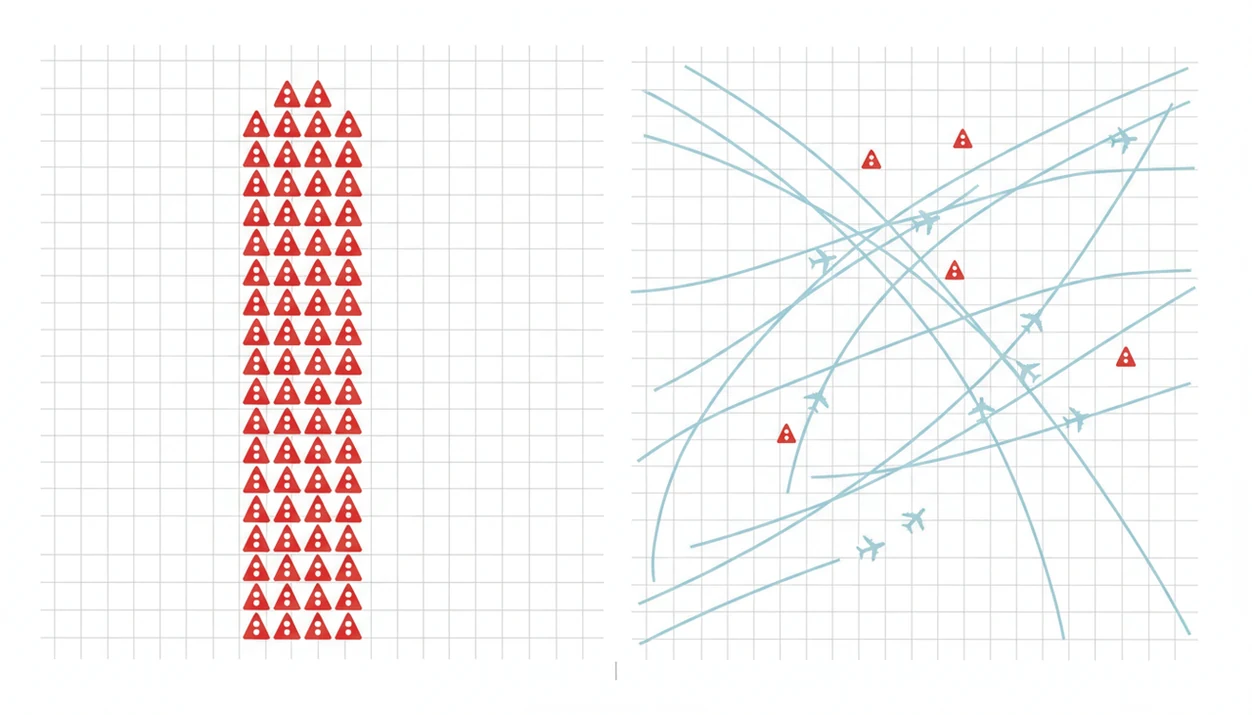
Raw annual crash counts answer “how many events were recorded,” but exposure rates answer “how often events occurred relative to flying activity.” That difference is central to annual air crash trends.
Flight volume changes by decade, region, aircraft type, and operation category. A year with more departures can have more recorded events while still being safer per flight. Per a U.S. aviation trend summary, total U.S. crashes fell from 3,583 in 1982 to 1,581 in 2018, a nearly 56% decline, while the fatal share rose from 18.2% to 22.5%. Counts and severity both matter. The 1982 and 2018 figures should be cited inline to the underlying U.S. aviation trend source, not left as an uncited summary statistic source.
| Metric | What it answers | What it misses |
|---|---|---|
| Raw annual crashes | How many events were recorded in a year | Flight volume and exposure |
| Crashes per departure | Risk per takeoff cycle | Flight length and time airborne |
| Crashes per flight hour | Risk during operating time | Passenger load and distance |
| Crashes per passenger mile | Traveler exposure over distance | Small-aircraft operations with few passengers |
For year-by-year risk, exposure-adjusted rates are usually better than raw totals because aviation activity is not constant.
Fatal Crashes By Year And Fatality Spike Patterns
Do fatal crashes by year show the same trend as total plane crashes? Not exactly, because fatal crashes, total crashes, and total fatalities measure different things.
A fatal crash is an accident with at least one death. Total fatalities count the number of people killed across those accidents. One high-casualty event can dominate a year’s fatality total, even if the number of fatal accidents is not unusual.
The 1996 global fatality total is a useful warning label. Published aviation accident summaries report 2,533 aircraft crash deaths in 1996, described as a 37-year high source. That does not mean every following year carried the same risk.
One year can shout.
Multi-year averages are more stable because they reduce the effect of rare catastrophic events. The same logic applies when reading fatal plane crash trends, where the key question is whether the pattern persists after the spike is removed.
Commercial Airline, General Aviation, And Other Operation Categories
Annual aviation accident totals should be read by operation category because scheduled airline flying, general aviation, cargo, charter, military, helicopter, and experimental operations have different exposure and risk profiles. Mixing them without labels can distort public perception.
| Operation category | Typical annual-table issue | Interpretation note |
|---|---|---|
| Scheduled commercial airline | Low event counts, high public attention | Raw deaths can spike after one major crash |
| General aviation | Many small-aircraft events | Often drives total accident counts |
| Cargo and charter | Smaller datasets | Needs operation-specific exposure |
| Military | Separate reporting systems | Often excluded from civil datasets |
| Helicopter and experimental | Different mission profiles | Not directly comparable with airlines |
Commercial airline accidents are rare compared with general aviation events, but airline accidents receive more coverage. The commercial aviation vs general aviation accidents distinction is one of the first checks to make before drawing conclusions.
AirCrashDB-style category filters matter because they stop unlike events from being treated as one safety signal.
NTSB Plane Crashes By Year And U.S. Data Notes
Does NTSB plane crash data show all yearly crashes worldwide? No. NTSB data primarily applies to U.S. aviation accidents and incidents, with separate rules from global airline-only lists.
The National Transportation Safety Board investigates U.S. civil aviation accidents and selected incidents. Its records may include general aviation, airline, cargo, instructional, and other operation types, depending on the event. Per a published aviation accident summary, the NTSB investigated 1,581 aviation accidents and incidents in 2018, with 847 deaths and 768 injuries reported source.
That figure should not be compared directly with a global commercial airline fatal-accident table. The source status is different. The scope is different. Final annual numbers can also change after factual reports, probable cause findings, and event classifications are completed.
On a research desk, appendix pages spread across the desk tell the same lesson: early totals are useful, but final dockets carry more weight.
Common Mistakes In Annual Air Crash Trend Tables
Common mistakes in annual air crash trend tables usually come from treating unmatched data as if it were comparable. The fix is plain labeling, not more dramatic wording.
- The raw-count mistake: Do not compare totals across decades without flight exposure, because departures, aircraft utilization, and passenger miles change.
- The spike-year mistake: Do not treat one high-fatality year as a permanent trend unless nearby years show the same pattern.
- The category-mixing mistake: Do not combine airline, general aviation, military, cargo, and helicopter events without clear labels.
- The preliminary-data mistake: Do not assume newer figures are final while investigations are still open.
- The cause-inference mistake: Do not infer pilot error, weather, or mechanical failure from annual counts alone.
A good aviation accident database with plane crash statistics, incident reports, fleet safety records, and recent accident news delivers structured context, not instant blame or unsupported airline rankings.
For case-level source review, aviation accident reports are better than summary charts.
Limitations
Annual aviation accident statistics are useful, but they are not a complete measure of flight safety. The limitations should be read before comparing years.
- Reporting systems vary by country, regulator, investigation authority, and time period.
- Some datasets focus only on certain regions, aircraft sizes, operation categories, or civil aviation events.
- Raw annual counts do not include exposure, near-misses, avoided accidents, or normal flights completed safely.
- Fatality totals can be distorted by rare high-casualty events.
- Historical datasets may be revised as archives improve, and recent datasets can lag while investigations remain open.
- Cause categories such as pilot error, weather, maintenance, or mechanical failure may change after final reports.
- Hospital, insurance, legal, regulator, and investigation datasets may count different events.
- Aircraft registration, operator name, and aircraft variant can change between early reports and the final docket.
A preliminary report is not a final report. That small distinction prevents many bad charts.
FAQ
How many planes crash each year?
The answer depends on scope: all aviation, commercial airlines only, general aviation, incidents, or fatal accidents. Raw annual totals should be paired with exposure measures.
Are plane crashes increasing yearly?
Long-term annual accident counts have generally declined, although individual years can fluctuate. Fatality totals are especially sensitive to rare catastrophic events.
What year had the most plane crash deaths?
Fatality rankings depend on the dataset and scope. The year 1996 is often cited as a notable global spike, with 2,533 aircraft crash deaths in supplied research.
What counts as a fatal plane crash?
A fatal plane crash is an aviation accident that results in at least one death under the relevant reporting rules. Definitions can vary by authority.
Are airline crashes counted separately from general aviation crashes?
Many datasets separate scheduled airline operations from general aviation, cargo, charter, military, helicopter, and experimental categories. Air Crash DB uses category labels where available.
Why do plane crash totals differ between sources?
Totals differ because sources vary by geography, aircraft type, incident definition, investigation status, and methodology. Early reports may also change after final classification.
Is flying safer than it was in previous decades?
Exposure-adjusted aviation safety has generally improved, especially for scheduled commercial aviation. Raw yearly counts still need flight volume and operation-category context.
Where does NTSB plane crash data apply?
NTSB data primarily covers U.S. aviation accidents and incidents. It should not be treated as a complete global count.
Do plane crash fatalities show true aviation risk?
Fatalities are important, but they can be distorted by rare high-casualty events. Air Crash DB and similar tools should pair deaths with exposure rates and source notes.