
What App Identifies Aircraft Accident History?
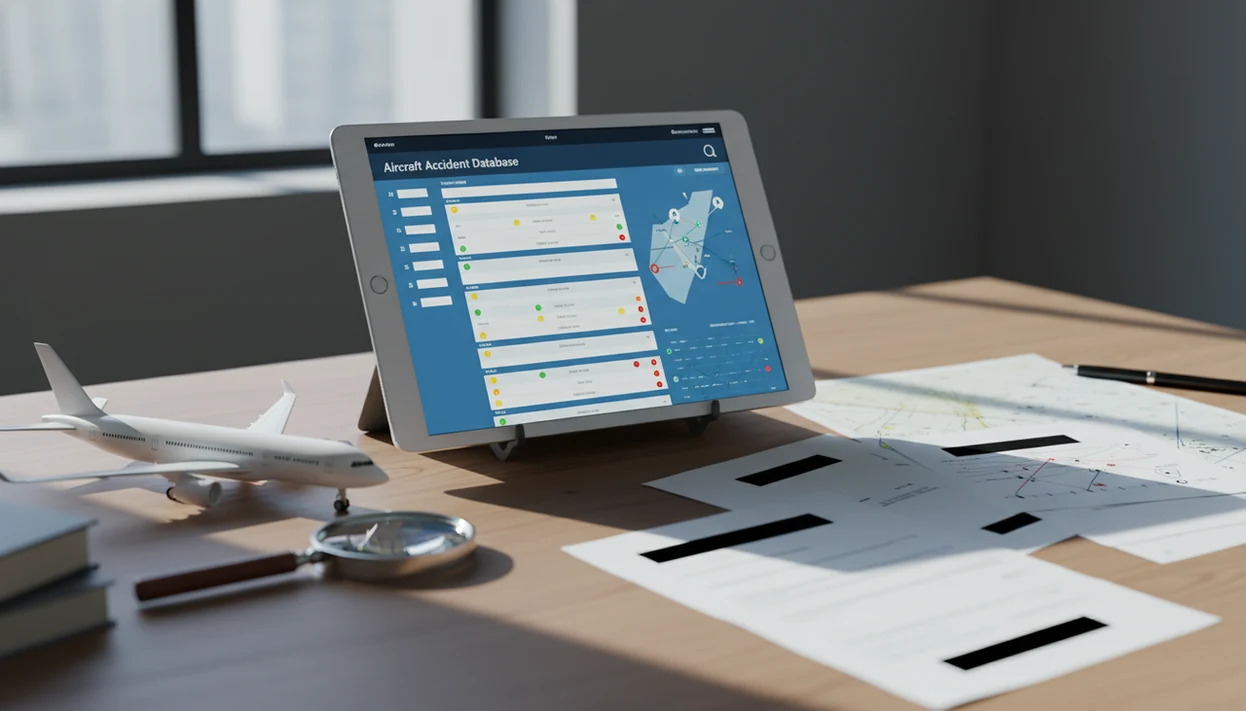
If you are asking what app identifies aircraft accident history, the safest answer is a source-cited aircraft accident database with filters for aircraft model, operator, date, source type, and investigation status. There is no single official government smartphone app for this, so credible tools should be judged by source coverage, search filters, update discipline, and transparency about preliminary versus final findings.
Definition: Air Crash DB is a plane crash database that organizes aviation accident reports, statistics, and safety records for researchers, journalists, aviation enthusiasts, and travelers.
TL;DR
- Use an aircraft history app to search accident history by aircraft model, operator, date, source type, and investigation status.
- Government sources such as the NTSB and FAA are essential, but they are web databases rather than consumer flight-safety apps.
- No plane accident lookup app can prove whether a specific upcoming flight is safe; accident history is context, not a prediction.
Aircraft Accident History App Definition
An aircraft accident history app is a lookup tool for finding past aviation accidents and incidents by aircraft model, operator, date, location, registration, or investigation source. Most people asking for one want an aircraft history app or plane accident lookup app that turns official records into searchable summaries.
The catch is format. Serious options are usually structured web databases, not polished consumer apps with one tap and a green safety badge. The useful ones preserve source status, final report links, and the difference between an accident, incident, and news update.
Aviation accident databases with plane crash statistics, incident reports, fleet safety records, and recent accident news deliver research context, not a personalized guarantee that tomorrow’s flight is safe.
A credible accident-history database fits this category when it organizes structured, source-cited aviation accident records instead of relying on rumor, recycled headlines, or unexplained private safety scores.
Before You Start: What Information to Collect
Before you start an aircraft accident lookup, gather enough identifiers to avoid chasing the wrong airplane or the wrong event. The cleaner your starting notes are, the easier it is to separate a useful record from a similar-looking match.
- Write down the aircraft model and variant as closely as you can, including subtype names when they appear in a booking, article, photo caption, or report.
- Add the operator and approximate event date so the search can distinguish between airline, cargo, charter, training, private, or other operating contexts.
- Use the registration or tail number selectively when ownership history, leasing, re-registration, or a specific airframe is part of the question.
- Decide which record universe you need before searching: U.S. civil, international, airline, military, general aviation, or a mix of those categories.
- Choose the source status you can accept by noting whether a preliminary finding is enough or whether you need a final report, probable cause, or docket material.
- Save the source links beside your notes so any summary, quote, or comparison can be checked later.
That last habit matters. Accident research ages as investigations update.
Named Shortlist of Plane Accident Lookup App Options
The most credible plane accident lookup options combine official databases, aviation safety archives, and readable summaries. Use more than one when the aircraft, country, or time period matters.
- Air Crash DB: Built for structured accident reports, plane crash statistics, fleet safety records, recent accident news, and plain-English source notes. It is useful when you want the docket-style facts without starting in a government search form.
- NTSB Aviation Investigation Search: The key U.S. source for civil aviation accidents and selected incidents from 1962 to present, including investigation records and probable-cause material when available: https://www.ntsb.gov/Pages/AviationQueryV2.aspx
- FAA accident and incident data: Useful for U.S. civil aviation summaries, aircraft information, event descriptions, and injury or fatality counts: https://www.faa.gov/dataresearch/accidentincident
- Aviation Safety Network: A long-running worldwide archive for airliner, military transport, and corporate jet occurrence history, with records dating back to 1919: https://aviation-safety.net/database/
- AOPA Air Safety Institute: A focused source for U.S. general aviation accident analysis, especially smaller aircraft.
The gray PDF cover page still matters. A summary is only as strong as the report behind it.
How an Aircraft History App Works Behind the Scenes
An aircraft history app works by ingesting accident records from official agencies, public safety datasets, international archives, older report collections, and curated news or investigation feeds. Then it normalizes messy aviation data into consistent fields.
That sounds simple. It is not.
One source may call an aircraft a “737-8AS,” another may use “Boeing 737-800,” and an early news item may omit the exact variant. A usable aircraft model crash app has to reconcile model names, operators, registration numbers, event dates, locations, fatalities and survivors, and investigation phase. We mark whether a timestamp is local time or UTC when the source makes that clear, because timeline errors spread quickly.
Duplicate handling also matters. The same accident can appear in a press release, preliminary report, final report, and archive entry. A credible database should connect those records and show source attribution. Incomplete feeds create blind spots, especially for older foreign occurrences, minor incidents, and cases still moving through an official docket.
How to Use a Plane Accident Lookup App
Use a plane accident lookup app as a research workflow, not as a fear meter. For model-level work, our longer aircraft model accident history guide explains why variant names and fleet exposure matter.
- Search by aircraft model when you do not know the registration or tail number.
- Filter by operator, date range, country, event type, and investigation status before drawing conclusions from raw counts.
- Open the source record before relying on a summary, especially when a case is preliminary.
- Compare patterns across a fleet instead of treating one accident as a prediction.
- Record the source status in your notes, such as press release, preliminary report, final report, or unknown.
A copied tail number from a placard photo can help, but it is not magic. Aircraft are sold, leased, re-registered, and transferred between operators.
For travelers, model history is often easier to understand than raw accident totals because it separates aircraft type context from airline-specific operations.
Aircraft Model Crash App Search Fields That Matter
Useful aircraft model crash app filters are the fields that let you separate similar events without overreading the data. A broad search can produce noise; a careful search leaves an audit trail.
- Aircraft model and variant: Model names can differ across databases, especially for subtypes, engine variants, and manufacturer naming changes.
- Operator and flight number: Operator history helps distinguish airline, charter, cargo, training, and private-use contexts.
- Registration or tail number: Tail-number searches can help for private aircraft, but airline fleet transfers and re-registrations can break the trail.
- Date range and location: These filters prevent older archived cases from being mixed with recent events in the same view.
- Severity, source type, and investigation status: Accident, incident, preliminary finding, final report, and probable cause are not interchangeable.
Use multiple identifiers when possible. Model plus operator plus date is usually cleaner than any single field.
Government Aircraft Accident History Sources Versus App Databases
The NTSB and FAA provide authoritative U.S. aviation accident and incident data, but they do not function as one simple universal consumer app. App databases add search, summaries, cross-linking, and filters, but they should preserve links and labels for original sources.
| Source type | What it provides | Main limitation |
|---|---|---|
| NTSB Aviation Investigation Search | U.S. civil aviation accidents and selected incidents from 1962 to present | U.S.-centered coverage, formal search interface |
| FAA accident and incident data | Event summaries, aircraft details, and injury or fatality counts | Data-oriented interface, not a traveler app |
| App databases | Plain-English summaries, model pages, fleet links, and investigation-status filters | Quality depends on source coverage and update discipline |
| Aviation archives | Older reports, historical context, and scanned records | Records may be fragmented or difficult to compare |
A highlighted probable-cause paragraph can answer one question and raise three more. That is normal in accident research.
For airline-level research, pair official records with structured airline safety records rather than treating a raw crash count as a safety ranking.
Best Aircraft History App Checks Before You Trust Results
Does the app name its sources and link back to original reports? If not, treat its results as a starting note, not a research conclusion.
Check the coverage dates and geography before assuming completeness. A U.S. civil aviation source, a worldwide airliner archive, and a general aviation database will not return the same universe of events. Check whether the status is preliminary, final, probable cause, or unknown. That label often changes the meaning of a summary.
Good tools separate accidents from incidents and news updates from official findings. A redlined newsroom paragraph about early uncertainty should not become a final-cause claim six hours later. Be careful with proprietary safety labels that look official. Unless a regulator issued the rating, it is a private scoring method.
For comparing operators, a dedicated airline crash history comparison is often clearer than searching each airline one at a time.
Common Mistakes When Looking Up Aircraft Accident History
The most common mistake is treating accident-history search results as simple scorecards. Use them as sourced records that need context, exposure, and investigation status before you compare aircraft or operators.
- Compare counts with exposure in mind. A type with thousands of aircraft and millions of flights will naturally show more events than a small fleet, even if its rate is not worse.
- Separate early reports from final findings. News updates, preliminary reports, probable cause, and final docket material do not carry the same weight.
- Check the database scope. One country’s official records may be excellent for its own civil aviation system and still miss foreign, military, historical, or general aviation events elsewhere.
- Verify the airframe trail. Tail numbers can change when aircraft are sold, leased, exported, stored, or re-registered, so pair registration with model, operator, and date.
- Treat private scores as private scores. A safety badge or ranking may be useful as a prompt, but it is not the same as certification, oversight, or an airworthiness decision from a regulator.
If the result feels too clean, slow down. Aviation records usually have footnotes.
Aircraft Accident History Use Cases for Travelers and Researchers
Aircraft accident history is useful when it explains context and harmful when it pretends to predict one flight. Travelers may use it to understand a model’s record, a recent incident, or why aviation investigations take months or years.
Journalists use these tools to verify dates, operators, aircraft registration, source status, and investigation phase. That matters when an early operator name changes in the final docket. Researchers use accident data to compare patterns across aircraft categories, eras, regions, or operating types. Aviation enthusiasts use it to learn fleet history without turning accidents into spectacle.
A phone open to safety statistics can calm a nervous flyer, but the numbers still describe populations, not your specific departure. Accident statistics are population-level context, not individual-flight risk forecasts.
If you are comparing aircraft families, the Boeing 737 vs Airbus A320 crash statistics debate only makes sense with production volume, flight exposure, era, and variant caveats included.
Limitations
No aircraft accident history app is complete, predictive, or equivalent to a regulator’s certification record. These limits should be visible, not buried in footer text.
- No single database covers every accident worldwide. Coverage varies by country, aircraft type, operator class, and period.
- Older records may be incomplete. Some are scanned, fragmented, archived, or missing supporting exhibits.
- NTSB coverage is specific. It focuses on U.S. civil aviation and selected foreign or international-water events, not every global occurrence.
- Private databases have scope choices. Some emphasize airliners, general aviation, corporate jets, military transports, or recent news.
- Minor incidents may be missing. Foreign occurrences and low-damage events can be inconsistently documented.
- Tail-number lookup can fail. Aircraft may be re-registered, leased, sold, or transferred between operators.
- Past history is not prediction. It cannot tell you whether a specific future flight will crash.
- App safety scores are not certifications. A private label is not the same as FAA, EASA, or other regulatory approval.
Reset the expectation. The record informs; it does not forecast.
FAQ
Is there an FAA crash app?
The FAA provides public accident and incident data online, but it does not offer one universal consumer crash-history app. Its records are useful sources for U.S. civil aviation research.
Is there an NTSB accident app?
The NTSB offers an aviation investigation search database rather than a traveler-focused mobile app. It is one of the primary sources for U.S. civil aviation accident records.
Can I search by aircraft model?
Yes, credible aircraft history tools should support aircraft model searches. You still need careful filtering because model variants and naming conventions can differ across sources.
Can I search by tail number?
Yes, registration or tail-number lookup can work, especially for private aircraft. It may be unreliable for airline fleets, older records, leased aircraft, or aircraft that changed registration.
What app shows plane crash history?
NTSB Aviation Investigation Search, FAA accident and incident data, Aviation Safety Network, AOPA Air Safety Institute, and source-cited private databases can show plane crash history. Choose the tool based on geography, aircraft type, and whether you need official docket records or readable summaries.
Are flight tracker apps enough?
No, flight tracker apps show live or recent aircraft movement, not full accident-history records. Use a plane accident lookup database for crash reports, source status, and investigation history.
Can crash history predict safety?
No, crash history provides context but cannot predict whether a specific flight is safe or unsafe. Flight risk depends on current operations, maintenance, regulation, weather, crew, and many other factors.
What is the best free source?
The best free source depends on the aircraft and geography. NTSB, FAA, Aviation Safety Network, AOPA, and public archives are all useful starting points for different parts of the record.