What Happens After a Plane Crash Investigation Starts?
Quick answer: In plain terms, what happens after a plane crash is a structured sequence: emergency crews rescue survivors and secure the site, aviation investigators preserve evidence, and safety authorities analyze records, wreckage, weather, and human factors before issuing findings. The process is designed to prevent future accidents, not to produce instant blame.
Definition: A plane crash investigation is an official safety inquiry that documents evidence, reconstructs the accident sequence, identifies probable causes or contributing factors, and recommends changes to reduce future risk.
- Emergency response comes first: rescue, fire suppression, medical triage, airspace control, and crash-site security.
- A national accident investigation authority usually leads the safety investigation, with controlled participation from airlines, manufacturers, regulators, and other parties.
- Final reports often take months or years because investigators must verify recorder data, maintenance history, weather, crew actions, aircraft systems, and organizational factors.
Five facts about what happens after a plane crash
- Emergency response and crash-site security are the first priorities after a plane crash.
- A formal safety investigation can begin within hours, but final conclusions usually take much longer.
- Investigators recover recorders, document wreckage, interview witnesses, and collect operational records.
- Safety investigations are separate from criminal cases, civil lawsuits, insurance reviews, and compensation processes.
- Findings feed aviation safety databases, regulations, training, aircraft design, and maintenance changes.
The first confirmed facts are often plain: location, aircraft registration, operator, fatalities and survivors, and source status. The harder work comes later, when the official docket starts filling with recorder downloads, ATC audio, maintenance records, and witness statements.
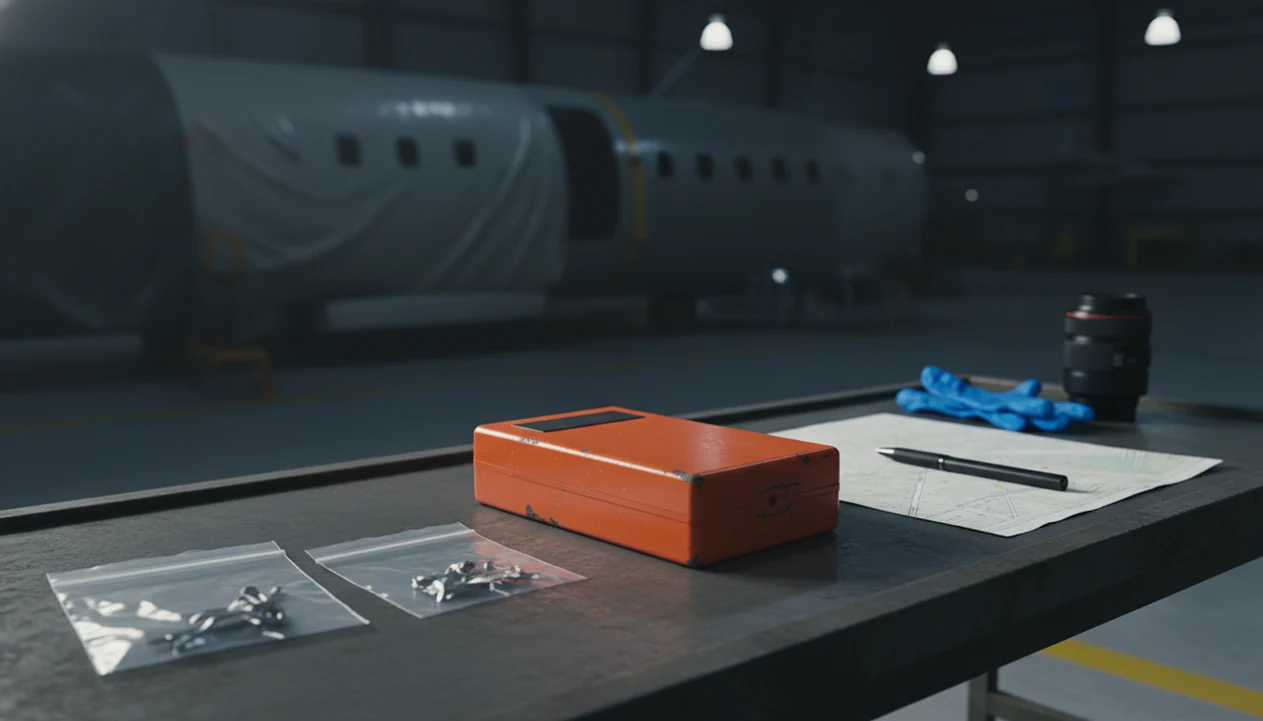
A folded timeline beside a black pen tells the real story. Dates move as evidence is verified.
How plane crash investigations work
Plane crash investigations work by building a tested timeline from evidence that did not all come from the same place. Investigators compare independent streams until the sequence of flight, impact, response, and system behavior is strong enough to support findings.
The key method is correlation, which means checking whether separate records point to the same event at the same time. Recorder data may show speed, altitude, warnings, or cockpit sounds. Wreckage can show breakup pattern, fire damage, control positions, and component fractures. Weather records, ATC audio, radar or ADS-B tracks, maintenance logs, dispatch paperwork, and crew records all add different angles. If one source conflicts with another, investigators do not simply pick the neatest story; they test timing, reliability, and context.
That is why probable cause is usually a chain, not a single broken part or single bad decision. A crash may involve design assumptions, maintenance history, training, weather, workload, procedures, and survivability factors at the same time. The main public output is not blame. It is the final report and its safety recommendations, which tell regulators, airlines, manufacturers, airports, or training programs what should change.
Before you read early plane crash reports
Before you read early plane crash reports, treat them as a starting point, not a finished account. The safest approach is to verify identity, source status, and timing before repeating any claim about cause.
- Identify the source type before weighing the report. An official safety board update, an independent aviation archive, and a local media dispatch can all be useful, but they do not carry the same authority.
- Confirm the aircraft details by looking for the registration or tail number, operator, location, route if available, and a timestamp tied to the event or the update.
- Separate facts from interpretation when a page mentions smoke, weather, maintenance, pilot actions, or mechanical failure. Those details may be observations, not analysis.
- Hold cause claims open until investigators publish a preliminary analysis, factual docket material, or final findings. Early certainty is often just speed wearing a uniform.
- Save the original link and access date because breaking-news pages, database entries, and agency notices can be corrected, expanded, or replaced as the record matures.
A careful first read keeps the timeline clean.
Step 1: Aviation accident response and crash-site control
What happens first after a plane crash? Local fire, medical, rescue, airport, and law enforcement teams respond before national investigators arrive. Their job is life safety, not cause analysis.
Airspace may be restricted, runways may close, and nearby airport operations may be halted or rerouted. Responders prioritize survivors, fire suppression, hazardous materials, fuel leaks, and preventing secondary harm to crews or bystanders. If the crash occurs near an airport, airport rescue and firefighting units may be first on scene; off-airport crashes rely more heavily on municipal responders.
Once life-safety work allows, the site becomes a controlled evidence scene. Access logs, perimeter tape, drone restrictions, and debris protection matter because a moved switch, tire mark, or fractured component can change the evidentiary record.
For breaking events, the cleanest early view is usually a source-labeled tracker of recent plane crashes, not a social feed racing ahead of confirmed facts.
Step 2: Plane crash investigation teams and legal authority
A national accident investigation authority usually leads the safety investigation after a plane crash, such as the NTSB in the United States.
Under international practice, the country where the accident occurs normally leads. That framework comes from ICAO Annex 13, which sets international standards for aircraft accident and incident investigations source. The aircraft’s state of registry, operator, design, and manufacture may also participate when relevant. That is why a crash in one country can involve investigators from several others, especially when the aircraft, engines, airline, and passengers cross jurisdictions.
The “party system” lets airlines, manufacturers, engine makers, and regulators provide technical help. They may supply manuals, engineering data, maintenance history, and specialist knowledge. They do not control the final conclusions.
Official releases are controlled for a reason. A gray PDF preliminary report is not the same as a press conference line, and neither carries the weight of a final report confirmed by investigators.
Step 3: Crash investigation steps for evidence preservation
Investigators preserve evidence by documenting the site before disturbing it. They photograph, map, tag, and measure wreckage, then decide what must be removed for lab testing or reconstruction.
Recorder recovery
When installed, flight data recorders and cockpit voice recorders are high-priority items. Search teams may use locator beacons, wreckage patterns, sonar, or hand searches, depending on terrain and water depth.
Wreckage documentation
The wreckage field can show impact angle, breakup sequence, fire patterns, and whether key components were attached before impact. Orange cones around a parked fuselage are not theater; they preserve position and access.
Operational records
Investigators collect maintenance logs, dispatch records, crew training files, air traffic control recordings, radar, ADS-B data, weather reports, and witness statements. Partial wreckage can still support a probable-cause finding when independent records point to the same sequence. The confirmed vs rumored gap is explained further in the confirmed vs unconfirmed plane crash reports guide.
Aircraft accident reconstruction and human-factors analysis
Aircraft accident reconstruction works by aligning independent data streams into one tested timeline. Investigators compare recorder data, radar, ADS-B tracks, ATC audio, weather, wreckage marks, maintenance records, and human performance evidence.
This is how the process works. Each data stream is treated as a check on the others, a method investigators call correlation. In plain language, one record should not carry the whole explanation if other records disagree.
Analysis may include structures, engines, systems, weather, air traffic control, maintenance, operations, survival factors, and organizational oversight. Human-factors work looks at workload, fatigue, training, cockpit communication, and decision-making.
Probable cause is usually a chain of contributing factors, not one dramatic failure. Large archives, including the NTSB aviation database and Aviation Safety Network, preserve accident history for trend analysis. Researchers often compare those records with plain-language summaries of plane crash causes.
How to use aviation accident response records in 5 steps
Use aviation accident response records by separating official status, preliminary facts, database summaries, and final recommendations. That keeps the record from blending with rumor.
- Check the official safety board for the lead authority, investigation phase, aircraft registration, and release date.
- Separate preliminary updates from final findings because early reports often list facts without assigning cause.
- Compare database entries across official dockets and independent archives, including tools like Air Crash DB, aviation-safety.net, and avherald.com.
- Avoid unsupported speculation when a recorder, wreckage item, or crew record has not been analyzed.
- Track final recommendations to see whether regulators, operators, manufacturers, airports, or training programs were asked to change procedures.
A useful aviation accident database does not rank airlines by fear; it labels source status, separates preliminary facts from final findings, and links readers back to the official docket when one exists.
Common mistakes when following a plane crash investigation
The most common mistake is treating early fragments as finished findings. A careful reader keeps cause, evidence, and database status separate until the official record catches up.
- Distinguish a preliminary report from a final probable-cause finding. Early reports often confirm facts such as aircraft identity, weather, or wreckage observations, but they usually do not explain why the accident happened.
- Treat social video captions as unverified unless an investigating authority or reliable source has tied the footage to the event, time, and location. A dramatic clip can be real and still be mislabeled.
- Wait after recorder recovery before assuming the cause is known. A flight data recorder or cockpit voice recorder must be downloaded, synchronized, checked for gaps, and compared with wreckage, maintenance, weather, and ATC records.
- Check definitions before comparing databases. One archive may count incidents, hull losses, military flights, or preliminary entries differently from another.
- Look at update dates and source labels. A clean table can still be stale if the official docket has changed since it was copied.
Fast certainty is the warning light. Slow verification is usually where the investigation is doing its job.
Step 4: Preliminary reports, final reports, and safety recommendations
Preliminary reports usually summarize known facts without assigning cause. They may confirm the aircraft, route, injury count, weather, crew information, and early wreckage observations.
Final reports carry more weight. They identify probable cause or contributing factors when the evidence supports that finding. Many investigations take 12 to 24 months, a range the NTSB also gives for many major investigations source, and complex cases can take longer, especially with deep-water recovery, multinational evidence, disputed data, or extensive lab testing.
Safety recommendations may target airlines, manufacturers, regulators, airports, training programs, maintenance procedures, or air traffic systems. A recommendation is not only a closing note. It is often the practical output that changes checklists, inspections, simulator scenarios, or certification assumptions.
For an unfolding case, a recent plane crash investigation timeline is useful only if it labels each entry by source, status, and last updated time.
Step 5: Legal responsibility after a plane crash investigation
Official safety investigations are not the same as criminal investigations. Safety boards focus on what happened, why defenses failed, and what can reduce future risk.
Civil claims, insurance reviews, compensation programs, and liability cases may run in parallel with the safety inquiry or after official findings. Those processes use different standards, different evidence rules, and different timelines. Criminal charges are not automatic. They usually require evidence of unlawful conduct, not just human error, system failure, or maintenance breakdown.
Victim identification, family assistance, and official notification are handled through separate emergency and legal channels. That work is often invisible in public dockets, but it is central to the response.
A boarding pass held with damp fingers is not a data point. It is why the language must stay careful.
Plane crash data archives and long-term aviation safety changes
Accident findings become part of official and independent databases that support trend analysis. Air Crash DB is a plane crash database that organizes aviation accident reports, statistics, and safety records for researchers, journalists, aviation enthusiasts, and travelers.
According to ICAO, 2023 had 2 fatal accidents involving large commercial passenger airplanes worldwide, with 86 fatalities, compared with a 10-year average of 6 fatal accidents and 207 fatalities per year source. The NTSB aviation database has recorded over 150,000 civil aviation accidents and selected incidents from 1962 onward source. Aviation Safety Network reports more than 23,000 safety occurrence descriptions dating back to 1919 source.
| Archive or dataset | Main use | Important caveat |
|---|---|---|
| NTSB aviation database | U.S. civil accidents and selected incidents | Strong official record, U.S.-centered |
| Aviation Safety Network | Global historical occurrence archive | Categories may differ from official boards |
| AirCrashDB | Structured summaries and source notes | Must be read with official docket status |
| ICAO safety statistics | Global commercial aviation trends | Aggregated, not case-level detail |
Limitations
Plane crash investigations can produce strong findings, but they do not remove every uncertainty. The source status matters.
- Not all wreckage or recorder data is recoverable, especially in remote terrain, deep water, conflict zones, or severe fire.
- Some reports end with undetermined causes or unresolved contributing factors.
- Official reports focus on safety causation and may not fully address moral blame, grief, or family concerns.
- Database records can be incomplete, delayed, differently categorized, or revised as new information appears.
- Preliminary information can change substantially before the final report.
- Legal, insurance, and compensation outcomes may not match the language or timing of the safety report.
- Tail numbers, operator names, and aircraft variants can shift between early reports and the final docket.
That last point looks small. It is not.
FAQ
Who investigates a plane crash?
A national accident investigation authority usually leads the safety investigation. In the United States, that authority is the NTSB for civil aviation accidents.
How long do crash investigations take?
Preliminary facts may appear within days or weeks. Final reports often take 12 to 24 months, and complex investigations can take longer.
What are black boxes?
“Black boxes” usually means the flight data recorder and cockpit voice recorder. They record aircraft parameters and cockpit audio when installed and operating.
Are black boxes always recovered?
No. They are designed to survive severe crashes, but recovery can be difficult or impossible in deep water, severe fire, remote terrain, or conflict areas.
Do investigators assign blame?
Safety investigators identify probable cause and contributing factors. Legal blame, criminal responsibility, and compensation are handled through separate processes.
Can a preliminary report change?
Yes. A preliminary report is an early factual snapshot, and later analysis can change the interpretation of those facts.
What happens to aircraft wreckage?
Wreckage is documented, stored, tested, and sometimes reconstructed. After the investigation and legal holds, it may be released, retained, or disposed of.
Where are crash records stored?
Crash records are stored in official safety board databases, FAA preliminary systems, and global accident archives. Air Crash DB can help readers compare case summaries with source status labels.